Trip Grade
Strenuous

Duration
13 days

Daily Activity
5-7 hours

Country
Nepal

Season
Spring/autonm

Group Size
2-12 Pax

Max Altitude
6,461M/21,190FT

Transportation
Private Vechile/helicopter

ACCOMMODATION
Tea house/tent

Trip Type
Expedition
Mera Peak Climbing offers an exclusive opportunity to summit Nepal’s highest trekking peak at 6,476 meters while enjoying breathtaking views of some of the world’s most iconic mountains. From the summit, climbers are rewarded with an unforgettable panorama of five spectacular 8,000-meter peaks including Mt. Everest, Makalu, Lhotse, Cho Oyu, and Kanchenjunga. The summit view from Mera Peak is considered one of the finest in the entire Himalayas, making this expedition a truly rewarding Himalayan adventure.
Mera Peak is one of the most alluring trekking peaks in Nepal because it perfectly combines cultural exploration, remote wilderness trekking, and high-altitude mountaineering. The journey takes climbers through beautiful Sherpa villages, peaceful forests of rhododendron and pine, alpine meadows, glacial valleys, and untouched mountain landscapes far away from the crowded trekking routes. Along the way, trekkers experience the warm hospitality, unique traditions, and authentic mountain lifestyle of the local Sherpa communities.
Despite its impressive altitude, Mera Peak is considered a straightforward and non-technical climbing peak, making it an excellent choice for trekkers and adventure seekers who want to experience Himalayan mountaineering without requiring advanced technical climbing skills. The climb mainly involves glacier walking and gradual snow slopes, making it suitable for individuals with moderate mountaineering experience, good physical fitness, determination, and a strong spirit of adventure.
At Adventure Sherpa Tracks, we have carefully designed our Mera Peak itinerary with proper acclimatization, gradual altitude gain, and contingency days to maximize safety, comfort, and summit success. Rather than rushing directly to the mountain, our itinerary allows climbers to adapt naturally to the high altitude while fully enjoying the journey and surrounding Himalayan environment.
Unlike the shorter and more commonly used route via Zatrwa La Pass, our Mera Peak Climbing via Pangom follows a unique and less-traveled trail beginning from Panggom Village — the hometown of our Sherpas in the lower Everest region. This special route provides a more authentic and culturally immersive experience while offering better acclimatization through a gradual ascent.
One of the major advantages of this route is that it avoids Lukla and all mountain flights, making the trip more reliable and flexible while also saving valuable travel time. Climbers can avoid possible flight delays and cancellations often experienced during peak trekking seasons. The route through Panggom also takes you deep into remote Himalayan landscapes rarely visited by large trekking groups, allowing for a quieter, more peaceful, and adventurous experience.
This expedition is ideal for trekkers and climbers who have limited time yet still wish to experience a complete Himalayan adventure combining culture, wilderness, trekking, and mountaineering. With the experienced guidance, local knowledge, and strong support of Adventure Sherpa Tracks and our Sherpa team, Mera Peak Climbing via Panggom becomes more than just a summit — it becomes a memorable journey through the heart of the Himalayas.
Our approach begins at Panggom Village — the ancestral home of our Sherpa guides — winding through remote forests and high settlements of the lower Everest region. This longer route provides superior acclimatization and a cultural immersion that the standard Zatrwa La trail cannot offer.
Why Helicopter Instead of Trekking Out?
This itinerary is built specifically for adventure seekers with limited time who want the full Mera Peak experience without the week-long slog back to Lukla and the uncertainty of fixed-wing flights. The helicopter exit solves three problems at once: it eliminates five to six days of repetitive descent over terrain already covered on the way in; it completely avoids the notorious Lukla flight delays and cancellations that routinely strand trekkers for days, especially during peak season; and it bypasses the rough jeep road sections entirely, meaning your first contact with tarmac after the mountains is Kathmandu itself. The entire expedition from Kathmandu to summit and back can realistically be completed in 12–14 days rather than the standard 18–21.
Trip Highlight
DAY
1
Upon your arrival at Kathmandu, you will be warmly welcomed by a representative from Adventure Sherpa Tracks at the airport. Our team will be waiting for you with a personalized signboard and will assist you with your transfer and immediate logistics.
After completing airport formalities, you will be comfortably transferred to your hotel in a private vehicle. The drive from the airport offers your first glimpse of Kathmandu’s vibrant streets, rich culture, and lively atmosphere — a perfect introduction to Nepal.Once you arrive at the hotel, you will be assisted with check-in procedures. The rest of the day is free for you to relax after your journey, recover from international travel, and settle into your room.
Depending on your arrival time, you may also have the option to explore the nearby surroundings, enjoy a quiet walk, or simply rest in preparation for the upcoming expedition briefing and trek preparation days. This first day is designed for comfort, smooth transition, and acclimatization to the local environment before beginning your Mera Peak adventure.
DAY
2
A relaxed preparation day in Kathmandu to help you settle in before the expedition.
After breakfast at the hotel, your tour guide from Adventure Sherpa Tracks will pick you up for a short sightseeing tour around the city. You will explore some of Kathmandu’s cultural highlights while also completing essential trip preparations.
During the day, we will conduct a full expedition briefing, gear check, and final preparation session to ensure you are fully ready for the Mera Peak journey.
The rest of the time is flexible for rest, last-minute shopping, or exploring the vibrant streets of Kathmandu at your own pace.
DAY
3
Fly to Pangom [2850m/93,48ft]: 4o min – 1 hrs
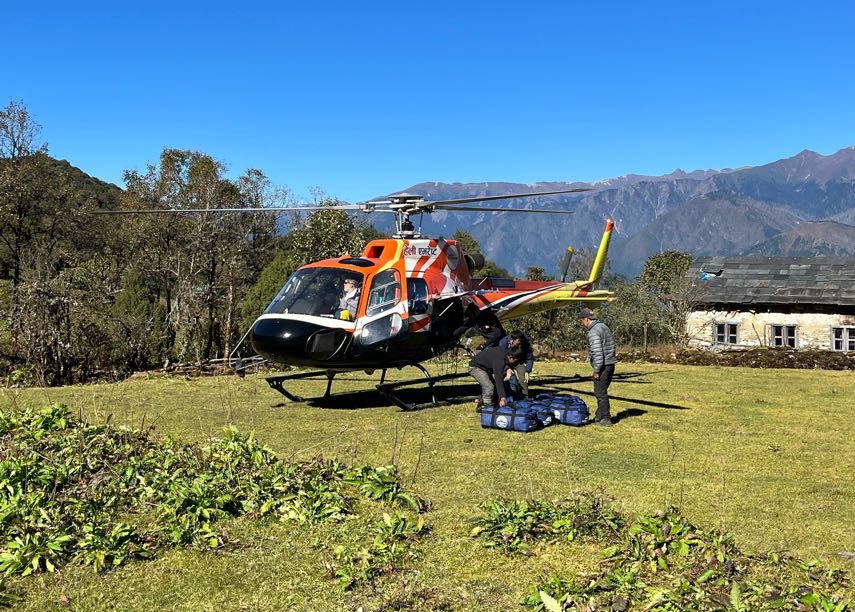
In the early morning, we take a scenic chartered helicopter flight to Panggom (2,840m), located in the lower Everest region and the hometown of our Sherpas. This spectacular flight offers breathtaking aerial views of rolling hills, deep river valleys, terraced fields, and the magnificent Himalayan landscape as we leave Kathmandu behind and enter the remote mountain region.
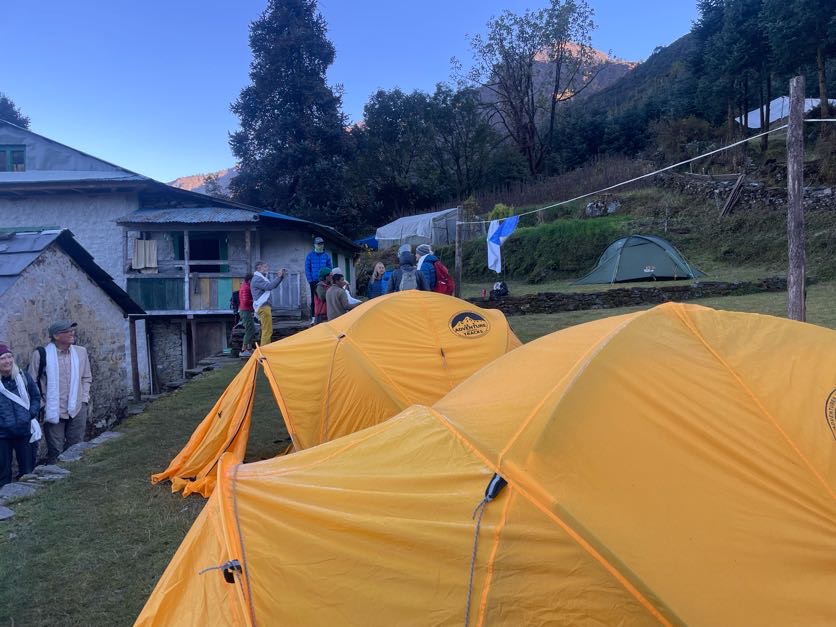
Upon arrival in Panggom Village, climbers are welcomed into a peaceful traditional Sherpa settlement surrounded by beautiful forests and mountain scenery. The day is kept relaxed to allow proper rest and acclimatization before continuing further into the Himalayas.
You will also have the opportunity to explore the village, interact with local Sherpa families, and visit the nearby monastery to experience the rich Buddhist culture and spiritual atmosphere of the region. Overnight camp in Panggom Village.
DAY
4
Pangom to Nigmsa (Shibuche)
Elevation: ~2,846m → 2,745m | Duration: 4–5 hrs | Distance: ~8 km
After an early breakfast in Panggom, we begin our trek with a gradual ascent through peaceful Sherpa villages and forest trails toward Panggom La Pass (3,200m). On clear days, the pass offers beautiful views of Mera Peak and the surrounding Himalayan ridges. The trail then descends through Sibuje Danda before continuing north across the Peseng Kharka Khola and along the remote ridgelines of Peeng Kharka Danda.
Walking through a mix of rhododendron forests, open alpine terrain, and quiet wilderness trails, the journey offers a true off-the-beaten-path Himalayan experience as the beautiful Hinku Valley slowly opens ahead. After crossing the Ningsow stream and passing through dense forest, we arrive at the peaceful village of Ningsow (Nigmsa) for an overnight stay.
Depending on the team’s pace, weather conditions, and time availability, we may continue further trekking to Ramailo Danda for the overnight stay.
DAY
5
Nigmsa (Shibuche) to Chhatra Khola [2,800m] — 7–8 hrs
Elevation: 2,745m → 2,800m | Duration: 7–8 hrs | Distance: ~12 km
Start early from Nigmsa, as this is the longest and most demanding day of the lower approach. The trail heads uphill immediately out of the village, climbing steadily before descending for a while, then ascending once more through dense rhododendron and bamboo forest, past mani walls and quiet ridgelines, until you reach Ramailo Danda at around 3,276m — whose name fittingly means "pleasant hill" in Nepali. The reward for the effort is immediate: from this ridge you are treated to extraordinary views of Mera Peak's towering glacier face to the north and the sweeping Salpa ridge to the south, making it the finest viewpoint of the entire day and a natural spot to rest and take in the panorama. Continuing beyond Ramailo Danda, the trail negotiates several more ascents and descents before crossing into Makalu Barun National Park — a remarkable moment on the journey. Established in 1991 and covering 1,500 sq km with an additional 830 sq km buffer zone, it is the only protected area on Earth with an elevation gain exceeding 8,000m, encompassing everything from near-tropical monsoon forests to permanently snow-capped peaks, and the skyline within confirms it — Mt. Makalu (8,463m), Mt. Chamlang (7,319m), Mt. Baruntse (7,129m), and Mera Peak (6,654m) all form part of the rugged horizon. From here, the route follows the Pasang Lhamu trail — named in honour of Pasang Lhamu Sherpa, the first Nepali woman to summit Everest — winding through dense forest along narrow, occasionally muddy paths with little human activity, all the way down to Chhatra Khola. This remote forested stretch is prime habitat for the elusive Red Panda; walk quietly, scan the oak and bamboo canopy, and you may be rewarded with a sighting of one of Nepal's most beloved endangered animals. The park is also home to musk deer, Himalayan black bear, snow leopard, Himalayan tahr, and over 430 species of birds including the Himalayan Monal. Arrive at the small riverside settlement of Chhatra Khola, rest your legs, dry your boots, and prepare for tomorrow's climb — the real alpine adventure begins from here.
DAY
6
Chhatra Khola to Kothe [3,691m / 12,109ft] — 6–7 hrs | ~15 km | Ascent: +891m
After breakfast, depart Chhatra Khola (2,800m) and head northward on the main trail towards Mera Peak, marking a clear shift in the character of the journey — the lower jungle-clad ridges are now behind you, and the Hinku Valley begins to draw you in. The trail first runs alongside the Majang Khola, after which it merges with another trail that moves alongside the Hinku Khola, the principal river draining the entire Hinku Valley all the way down from the glaciers above. From Chhatra Khola, you will encounter various tea establishments as you approach the Hinku Khola from the north, offering welcome refreshment stops as the trail begins its steady climb in elevation. The path is a long and gradual ascent through a landscape that transitions beautifully from the dense rhododendron, oak, and pine forests of the lower valley into more open, airy terrain as the valley walls narrow and the mountains close in around you. The trail essentially remains along the river bed for a significant stretch, with the sound of the Hinku Khola as a constant companion. Continuing northward, the trail moves straight ahead towards Tashing Ongma, a small, seasonally inhabited settlement where local families operate basic tea shops during the trekking season — a good spot to stop for lunch and rest your legs before the final push. Tashing Ongma also has small Buddhist gompas and shrines adorned with prayer flags and mani stones, offering a glimpse into the spiritual life of the local Sherpa and Rai communities. Beyond Tashing Ongma, the trail crosses the bridge over the Sanu Khola — a clear mountain stream tumbling down from the hillside — before the final uphill climb leads you into Kothe. Kothe is a small settlement nestled in the Hinku Valley, surrounded by alpine forests, and serves as a crucial stop for acclimatization, offering trekkers a glimpse into the lives of people living in this remote region, with simple teahouse accommodations and stunning mountain views. At 3,691m, Kothe sits at the point where the alpine area truly begins — the treeline thins, snow-covered peaks start to dominate the skyline, and for the first time, Mera Peak itself looms unmistakably in the distance ahead, a powerful reminder of why you are here. The teahouses in Kothe offer basic lodging with shared facilities, filling meals, and the chance to swap stories with fellow trekkers — settle in, rest well, and savour the deepening wilderness around you. Tomorrow the real altitude gain begins
DAY
7
Kothe to Thaknak [4,358m / 14,297ft] — 3–4 hrs | ~7.5 km | Ascent: +667m
Departing Kothe after breakfast, the trail follows the ridge of the Hinku Khola northward, trekking quite literally in the growing shadow of Mera Peak as it begins to dominate the skyline ahead. As you gain height, sweeping views of Kusum Kanguru, Mera Peak, and the surrounding peaks open up steadily, rewarding each upward step with a more dramatic panorama. The trail is relatively short and manageable today — a welcome contrast to the long haul from Chhatra Khola — giving your body a gentler opportunity to adjust to the rising altitude. Lunch is taken at Gondishung, the summer herders' settlement on the west bank of the Hinku Drangka, a cluster of stone huts used seasonally by yak herders who bring their animals to the high pastures each summer. Beyond Gondishung, the trail passes the remarkable Lungsumgba Gompa, a Buddhist shrine built approximately 200 years ago, where Mera Peak and its climbing route are scripted into rock — a fascinating piece of ancient rock-carving architecture that reminds you this mountain has been known and revered by local communities long before modern climbing expeditions arrived. A short walk from the gompa brings you to Thaknak, a summer grazing area at 4,358m with primitive lodges and shops, sitting at the threshold of the true alpine zone where the treeline fades, moraines appear, and the glacier world of Mera Peak begins in earnest. Overnight in Thaknak.
DAY
8
Today is an important acclimatization and rest day to help the body adjust properly to the increasing altitude before moving higher toward Mera Peak. In the morning, we take a short acclimatization hike up to around 5,000 meters, following the principle of “climb high, sleep low” to support safe altitude adaptation while enjoying impressive views of the surrounding mountains.
After returning to camp for lunch and rest, the afternoon is spent organizing and checking climbing equipment for the upcoming mountain section. Our guides will assist with gear preparation and provide a briefing on the climb ahead. The remainder of the day can be used to relax, hydrate, and recover before continuing higher into the mountains. Overnight camp.
DAY
9
After breakfast in Thaknak, we begin a short but important climb in altitude as we cross the 5,000m mark for the first time on the expedition. The trail follows the lateral moraine of the Dig Glacier toward Dig Kharka, offering striking views of Charpate Himal and the surrounding high alpine landscape.
From here, the scenery becomes increasingly rugged as vegetation disappears, giving way to a dramatic world of rock, ice, and glacial moraine. The route continues past the terminal sections of the Hinku Nup and Shar glaciers, where the terrain becomes more demanding and every step requires a steady, controlled pace due to the altitude.
We then arrive at Khare (5,045m), the final settlement before Mera High Camp. Located in a stunning glacial basin, Khare offers incredible close-up views of the north face of Mera Peak, now dominating the skyline.
After reaching by midday, the afternoon is used for rest, and a short acclimatization walk around the surrounding ridges. As an essential acclimatization stop before the higher camps, Khare allows the body to properly adjust before the summit push. Overnight stay in Khare.
DAY
10
Acclimatisation Day at Khare [5,045m / 16,486ft]
A full day at Khare is not rest — it is one of the most important days of the entire expedition, and the body's unseen work at 5,045m is as demanding as any trail. This is where you will feel the altitude most sharply, and where your body will do much of its physiological adaptation work. The morning begins with an acclimatisation hike, heading upward from Khare toward the lower glacier in the direction of Mera La pass — not to summit, but to expose the body to greater elevation before descending back to sleep lower. There is a chance to hike up onto the glacier towards the Mera La pass, gaining altitude and returning to Khare for the night, which is the classic acclimatisation strategy — climb high, sleep low. The surrounding ridges also offer short exploratory walks with sweeping views of the Hinku Valley below and the great peaks above, including the northern face of Mera itself looming overhead as a constant reminder of what lies ahead
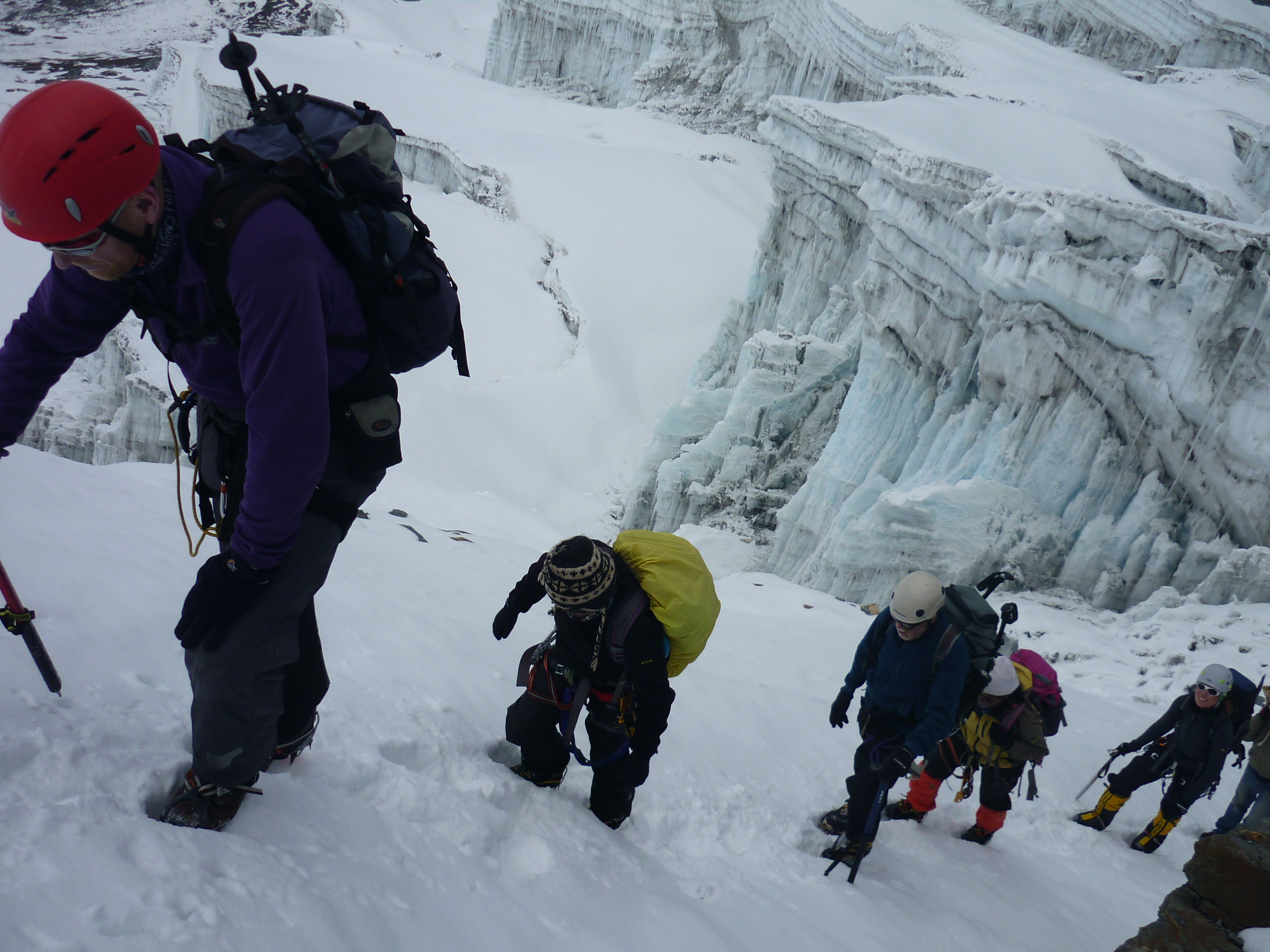
The afternoon is dedicated to a compulsory and thorough pre-climbing training session on the nearby slopes. Your Sherpa climbing guide conducts the technical training session covering crampon fitting and walking technique, ice axe use and self-arrest, rope movement, and a full briefing on the summit route. The training focuses on how to fix ropes, use an ice axe, and handle other climbing equipment, with practical instruction on ascending and descending systems on real glacier terrain. This is not merely theoretical — the training is conducted in a controlled environment close to the glacier, allowing you to practise skills under no pressure, with the focus firmly on practical application to ensure you feel confident before moving to higher elevations. A full equipment check also takes place at Khare — both the training and equipment check are compulsory before the climb. Even experienced trekkers with no prior mountaineering background gain enormously from this session; with proper acclimatisation and good weather, success rates on Mera Peak can reach 70 to 80 percent, but climbers who rush the itinerary or skip rest days see rates closer to 50 percent — a clear argument for taking this day seriously. Nights at Khare are frosty and crisp, with temperatures dropping well below -10°C, so use the evening to eat well, hydrate, check all gear meticulously, and sleep as much as possible. Tomorrow, the climb begins in earnest
DAY
11
Khare to Mera High Camp [5,780m / 18,958ft] — 5–6 hrs | ~7 km | Ascent: +735m
Since leaving Khare, we begin our ascent into the high alpine world of Mera Peak. The climb takes around 6–7 hours as we gradually move from rocky terrain into glacier travel.
The route first follows a boulder-strewn trail up to Mera Base Camp, before continuing toward Mera La Pass and onto the glacier. From here, we cross easy-angled snow slopes, carefully navigating crevasses as we gain significant altitude. Depending on conditions, we establish our own High Camp on the glacier in a quiet, scenic location away from the main lodge-run camp, offering a more independent and peaceful setting.
As we climb higher, the views open dramatically, revealing Everest, Makalu, Cho Oyu, Lhotse, Nuptse, Chamlang, and Baruntse. At around 5,780m, we set up High Camp and rest in preparation for summit day. Overnight at Mera High Camp.
DAY
12
Mera Peak Summit Day (6,461m) | 8–9 hrs | +~700m ascent
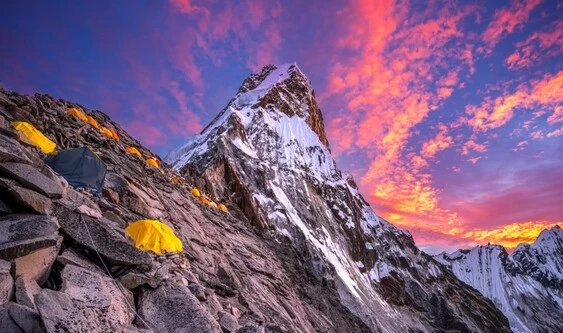
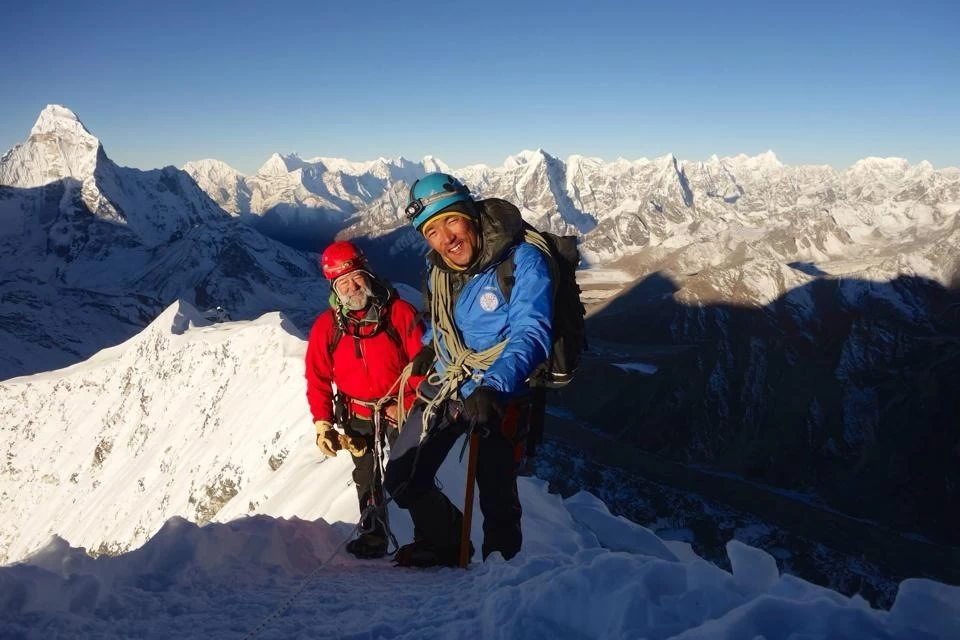
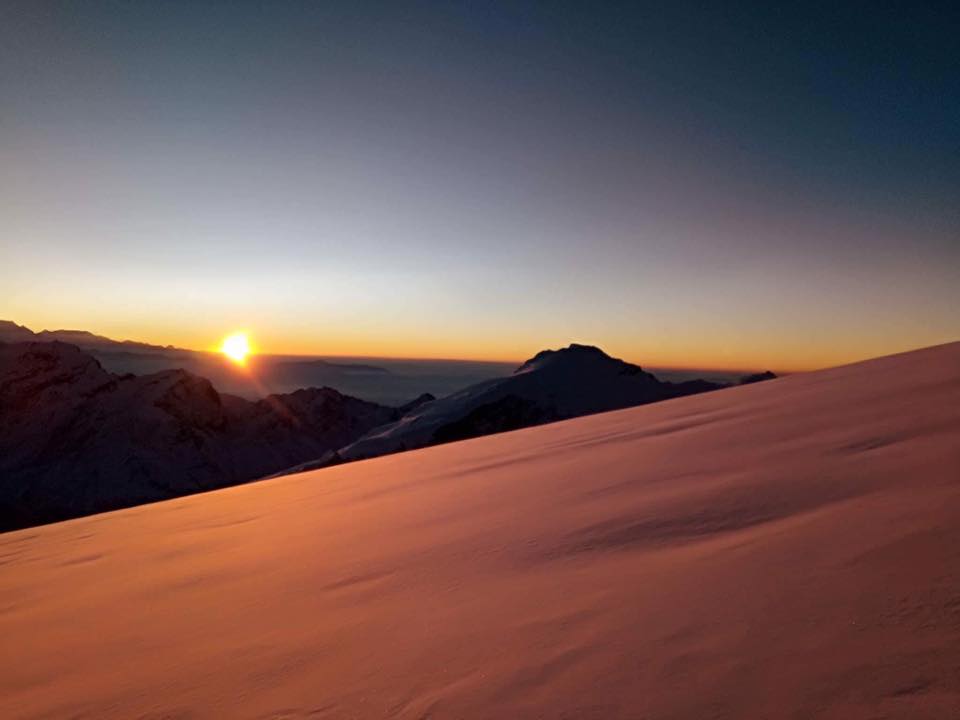
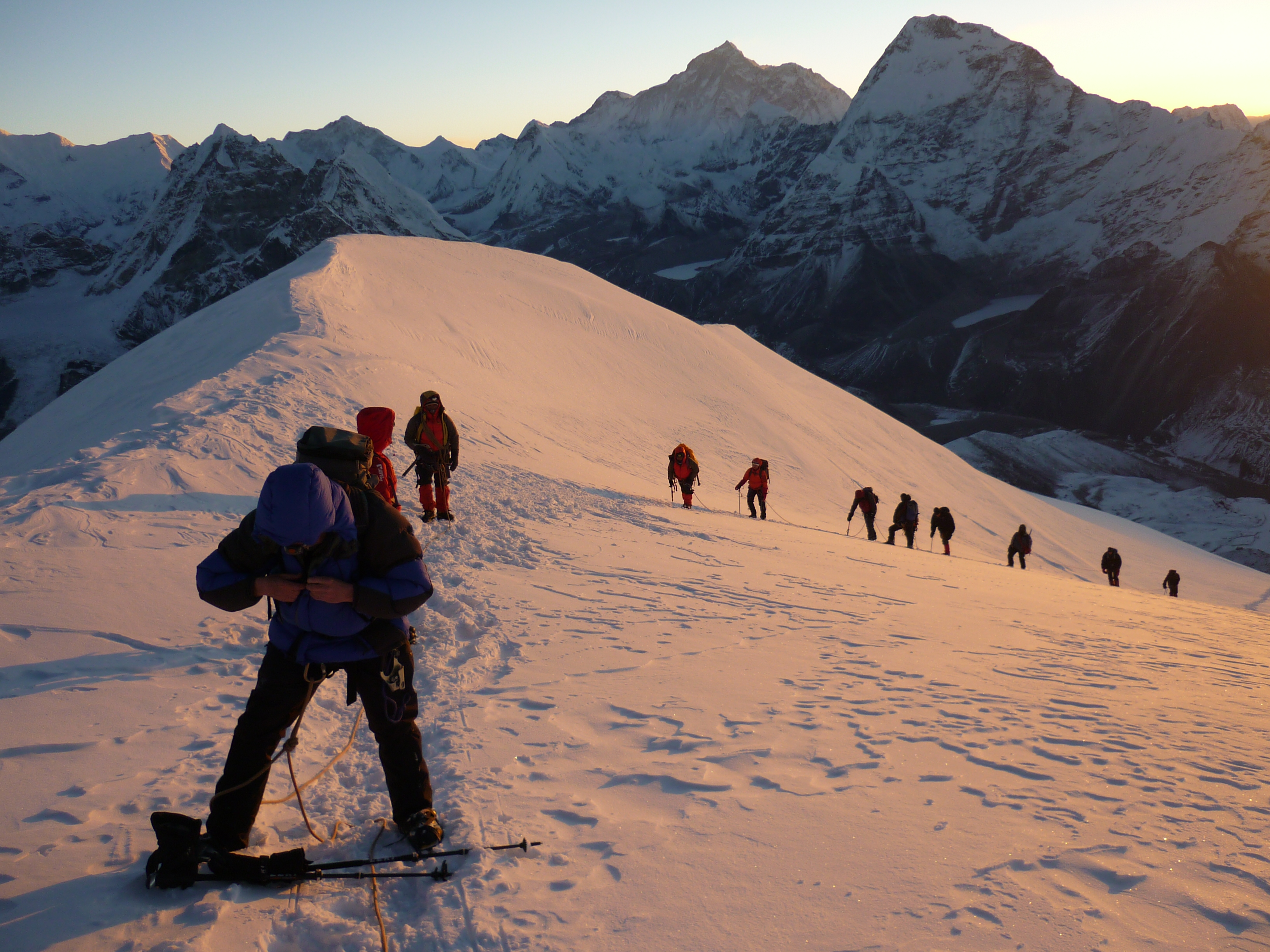
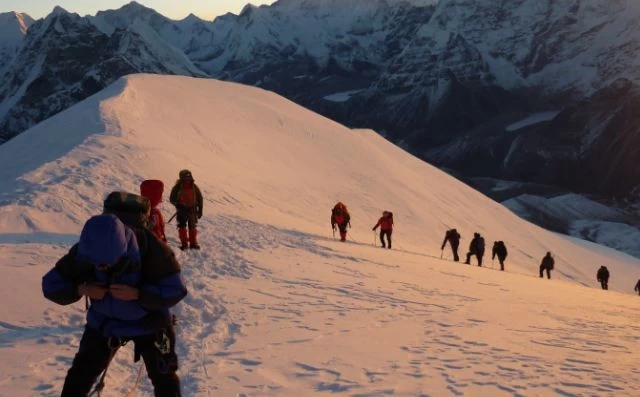
This is the most important and rewarding day of the expedition. We wake up around 2:00 AM and begin the climb after a light breakfast. The early hours are extremely cold, but as we ascend the glacier and move onto a broad ridge, the body gradually warms up with steady effort. The first light of sunrise paints the surrounding Himalayan giants in a striking red glow, creating an unforgettable alpine atmosphere.
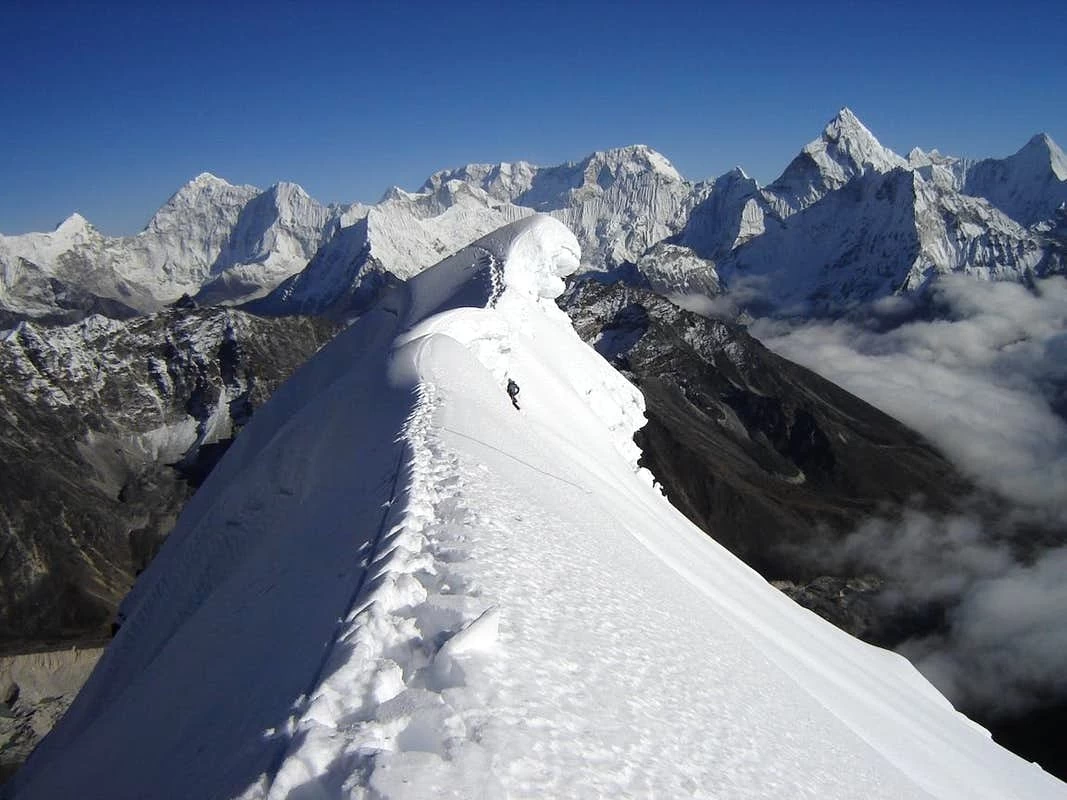
The route is generally non-technical, but the altitude makes progress slow and steady as we continue higher into thinning air. After a section behind the ridge, the summit cone comes into view again, marking the final push. Near the top, a fixed rope may be used if required by the climbing leader for safety.
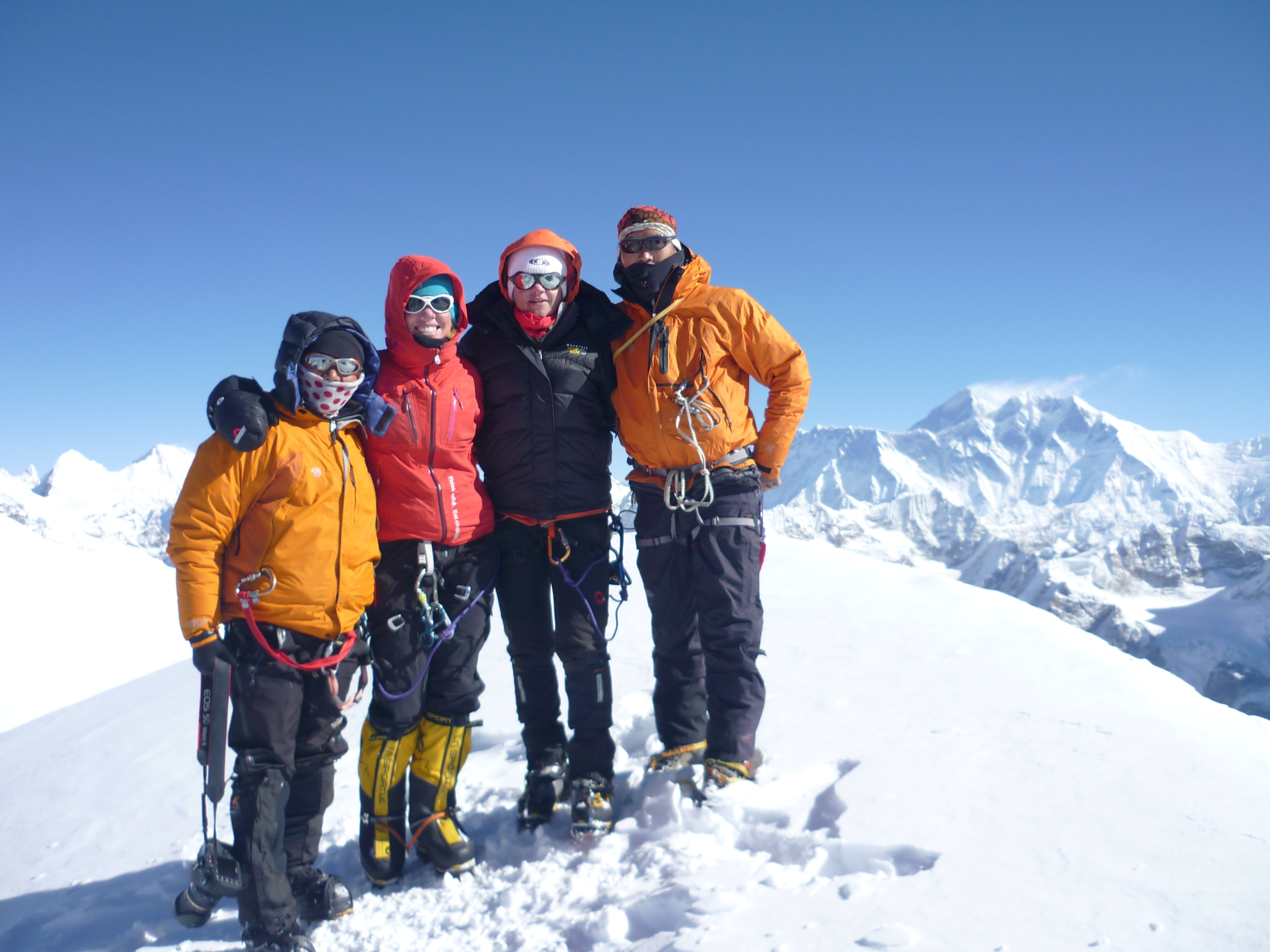
From the summit of Mera Peak (6,461m / 21,199ft), we are rewarded with one of the most spectacular panoramas in the Himalayas, including Mt. Everest (8,848m), Lhotse (8,516m), Makalu (8,463m), Cho Oyu (8,210m), Kangchenjunga (8,586m), Nuptse (7,855m), Chamlang (7,319m), and Baruntse (7,129m), among many others. After celebrating at the summit, we carefully descend back to High Camp for a short rest before continuing all the way down to Khare. Overnight in Khare.
DAY
13
Weather in the high Himalayas can be unpredictable, and summit conditions on Mera Peak may not always align with our planned schedule. This day has been thoughtfully reserved as a contingency — giving us the flexibility to attempt the summit when conditions are most favorable. If the expedition runs smoothly and the skies cooperate, this day simply becomes a bonus to enjoy the journey.
DAY
14
We retrace our steps from Khare down to Kothe along the familiar Himalayan trail, descending gradually through alpine terrain, glacial streams, and lush forested sections as the air grows warmer and thicker with every step.
Upon reaching Kothe, we celebrate the successful summit journey in true local style—sharing stories over traditional delicacies and sampling regional drinks and homemade wines that reflect the culture of the valley. It’s a well-earned moment of relaxation after days in high altitude.
We spend the night in Kothe, resting comfortably and reflecting on the achievement before continuing onward the next day.
DAY
15
Helicopter Return to Kathmandu — The Adventure Seeker's Exit
The whole philosophy of this itinerary has been about maximising adventure and minimising wasted time — and nowhere does that principle pay off more elegantly than at the end. Rather than retracing the full approach route on foot over several days, then battling the notoriously unreliable Lukla flight schedule, this itinerary closes with a direct helicopter flight from Khare back to Kathmandu, transforming what would be five to six days of descent into a single breathtaking 45-minute journey through the sky.
After descending from the summit back to Khare, the morning is spent resting, celebrating, packing gear, and savouring a final meal at altitude with Mera Peak towering above — a mountain you have now stood on top of. Then the helicopter lifts off from either from Thagnak or Kothe and the Hinku Valley falls away beneath you. As the helicopter climbs, travellers are treated to incredible panoramas of rugged valleys, winding rivers, and pristine forests, with the route crossing the stunning Hinku Valley and offering remarkable aerial views of iconic mountains including Mount Everest, Makalu, Lhotse, and Cho Oyu — a final, cinematic farewell to the range you have spent the past two weeks immersed in. The flight transports passengers from Kothe to Kathmandu via Lukla in approximately 45 minutes to 1 hour, landing you back in the capital in time for a hot shower, a proper meal, and a comfortable bed
DAY
16
Fly home
Our adventure in Nepal comes to an end today. There is nothing left to do but exchange emails with fellow trekkers and organize the memories captured along the journey.
A representative from Adventure Sherpa Tracks will escort you to the airport approximately 3 hours before your scheduled flight. As you head home, you’ll have plenty of time to reflect on the unforgettable experience in the Himalayas and begin dreaming about your next adventure in Nepal.
With Adventure Sherpa Tracks, your Mera Peak expedition comes to a successful and memorable conclusion, leaving you with lifelong memories of the mountains, the journey, and the spirit of the Himalayas.
Trip Start: 2026-10-08
Trip End: 2025-10-21
10 spots available
Trip Start: 2026-11-10
Trip End: 2026-11-22
5 spots available
Having the right equipment on your adventure trips will make almost as much difference to your success, safety, comfort, and enjoyment as any physical training you do. It is essential that you take the time to acquire the correct gear; don’t wait for the last minute to find out your local shop doesn’t have your size. This equipment is expensive, but you can often find great sales online and at your local gear store. The purpose of this gear list is to help guide your purchases.
This list is a guide. While you are required to bring everything on this list, there are numerous options, brands, and versions of each piece of equipment, unless otherwise noted. Using our current suggested brand list we encourage you to shop around, do research, use your experience and the listed features to find the best gear for you.
During your time in the mountains, you will encounter a very wide range of temperatures and weather conditions. At one end of this range is the pleasantly warm and beautiful low land, while at the other end of the spectrum is found the cold and often windy weather of the highest peaks in the world. The equipment you bring must function well in a wide variety of conditions. Your clothing should be warm, lightweight, dry quickly, and allow good freedom of movement. The layering principle, based on several thin layers of insulation
(rather than one thick one), covered with an outer weatherproof shell, meets these needs well.
A Note on Packing
For your international flights, we recommend that you pack all your equipment in your two duffle bags. Do not simply pack your backpack (since the straps can be damaged by the baggage handling machines). It is important to lock these bags for their trip. Depending on the airport, you may be able to put your travel locks on after TSA has searched the bags. If not, Lock the bags with Zip Ties. If the TSA cuts off the zip-tie to search your bag, they will replace it. You will still need the travel locks to lock your bags in the hotel and during the expedition. Generally, you will take one duffel up to Base Camp, and leave one in the hotel in Kathmandu with your belongings for your time in the city. Your trek in duffel will only be accessible in the evenings (with items such as changes of clothing, sleeping bag), and your day pack will hold vitals such as water, layering, blister kit, and camera.
Important Notes:
Tips:
Clothing
Footwear
Handwear
Headwear
Climbing Gears
Backpacking
Accessories
Hygiene and first aid
Others
1
Prior technical climbing experience is not mandatory. However, previous trekking experience at high altitude is highly recommended. Basic rope techniques and climbing instructions are provided by your Sherpa guides during the expedition.
2
The Panggom route offers a less crowded and more authentic Himalayan experience. It avoids Lukla flights, provides better acclimatization, and passes through remote Sherpa villages, forests, and high valleys in the lower Everest region.
3
The expedition typically takes around 12–14 days with the helicopter return option. This includes gradual acclimatization, summit preparation, and a faster, safer return to Kathmandu without retracing the full descent.
4
Climbing Mera peak itself is not very technical and doesn’t consist of a steep technical climb but the high altitude reaching 6461m at the summit makes this a challenging climb. Unlike other trekking peaks in Nepal, the climb to Mera peak is straightforward.
5
We recommend climbing Mera Peak in late April, May, late September, October, and November. We find that when we climb on Mera Peak, generally the best months are May and October. If you decide to climb in late March, early April or late October into November, you need to be ready for colder conditions.
6
There are several peaks, and among them, Mera Peak is one of them. It provides the view of five 8000 er including Everest. The peak gives a close-up view of Mount Everest, Cho Oyu, Makalu, Kanchenjunga, and Lhotse