Trip Grade
Challenging

Duration
32 Days

Daily Activity
4-7 hours

Country
Nepal

Season
Spring/Autonm

Group Size
2-10 Pax

Max Altitude
6,812m/22,343ft

Transportation
Private vehicle / Plane

ACCOMMODATION
Hotel/Lodge/Tent

Trip Type
Expedition
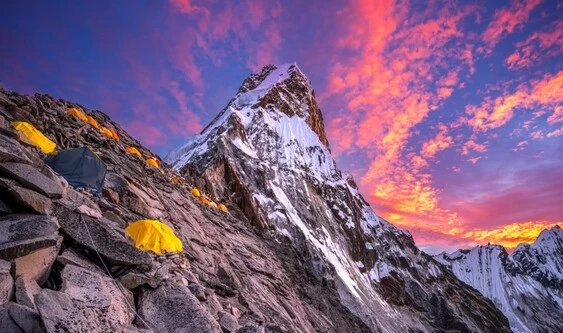
Ama Dablam (6,812m) — The Jewel of the Khumbu rises from the Himalayan heartland of eastern Nepal, widely considered one of the most beautiful mountains on earth — a peer to the Matterhorn and Khan Tengri in both form and reputation. The main summit stands at 6,812m (22,349 ft); the lower western peak at 6,170m (20,243 ft).
The name Ama Dablam is deeply rooted in Sherpa culture: Ama means "mother," and the two long ridges sweeping down from the summit are her arms, sheltering her child. The hanging glacier at the mountain's heart represents the Dablam — the sacred double-pendant locket worn by Sherpa women, holding images of the gods. It is a mountain that carries meaning before you ever rope up.
For trekkers approaching Everest Base Camp through the Khumbu, Ama Dablam commands the eastern horizon for days — a constant, breathtaking presence that few mountains anywhere can match.
The Climb
The South-East Ridge is the standard and most-frequented route, but do not mistake "standard" for easy. Despite its modest altitude by Himalayan standards, Ama Dablam is regarded as one of Nepal's most technically demanding peaks. Climbers must be proficient in both rock and hard water-ice climbing. Fixed ropes protect the most exposed sections, yet the mountain demands genuine competence — not just fitness.
We strongly recommend that first-time climbers on Ama Dablam first acclimatize and sharpen their skills on a recognised trekking peak such as Island Peak (6,189m), Mera Peak (6,476m), or Lobuche East (6,119m). These are not optional warm-ups — they are genuine preparation for what Ama Dablam will ask of you.
The Ama Dablam (6,812m) and Lobuche East (6,119m) expedition is designed as a complete Himalayan mountaineering experience rather than a standard peak-bagging itinerary. At Adventure Sherpa Tracks, we believe climbing in the Himalayas should be progressive, meaningful, and deeply immersive.
Our experience with the two-peak strategy has consistently resulted in higher summit success rates and improved team performance., our expeditions have shown significantly improved summit success rates and stronger team performance. By first summiting Lobuche East before attempting Ama Dablam, climbers gain essential altitude exposure, technical readiness, and psychological confidence at extreme elevation.
This is not just acclimatization—it is a structured ascent philosophy built around safety, learning, and success under the guidance of experienced Sherpa leaders who understand the mountains better than anyone else.
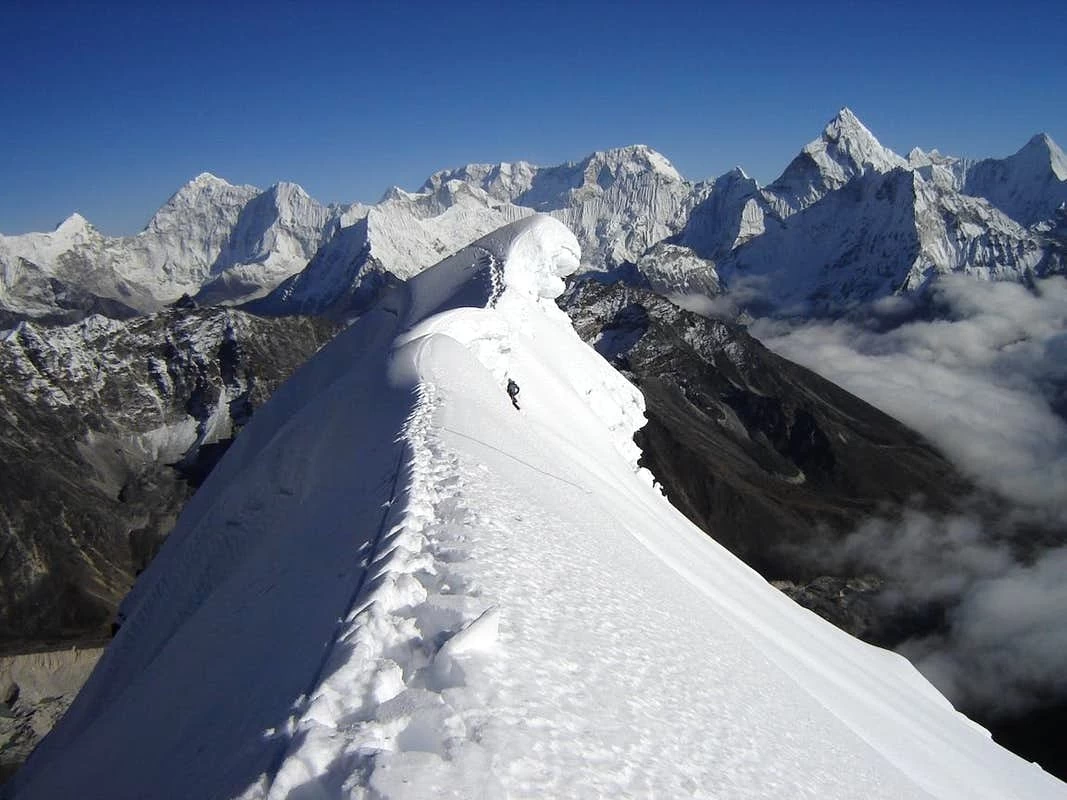
Ama Dablam is one of the most beautiful and technical peaks in the world. Its iconic South-East Ridge demands serious alpine skills and mental focus.
Climbers must be comfortable with:
Ama Dablam is not just a climb—it is a true alpine test of efficiency, endurance, and precision.
Lobuche East is both a powerful acclimatization peak and a serious climb in its own right. It provides the perfect progression into higher Himalayan objectives.
By summiting Lobuche East first, climbers gain confidence in high-altitude movement, rope systems, and summit-day endurance.
This expedition is designed as a full Everest region traverse, combining culture, altitude, and iconic landscapes:
Kathmandu → Lukla → Namche Bazaar → Gokyo Valley → Gokyo Lakes → Cho La Pass (5,420m) → Everest Base Camp region → Lobuche East Summit → Ama Dablam Base Camp → Ama Dablam Summit
This route is intentionally designed to be richer and more progressive than the traditional approach. Instead of a direct ascent, climbers experience:
The Gokyo Valley route offers superior scenery, fewer crowds, and a more effective physiological adaptation process compared to the standard Namche–Tengboche approach.
Our acclimatization system is one of the strongest success factors of this expedition.
We follow a multi-phase altitude adaptation model:
Scientific acclimatization principles show that staged exposure above 5,000m significantly reduces AMS risk and improves summit performance.
On Ama Dablam, climbers complete rotation climbs on the Southwest Ridge before the final summit push, ensuring full adaptation to technical and altitude demands.
This expedition is designed for serious trekkers and aspiring mountaineers, not beginners.
Recommended requirements:
This is a challenging but achievable expedition for prepared climbers seeking their next step into serious Himalayan mountaineering.
For those without prior 6,000m experience, Adventure Sherpa Tracks can recommend pre-training peaks such as Island Peak or Lobuche East separately.
At the heart of every expedition is the spiritual tradition of the Himalayas.
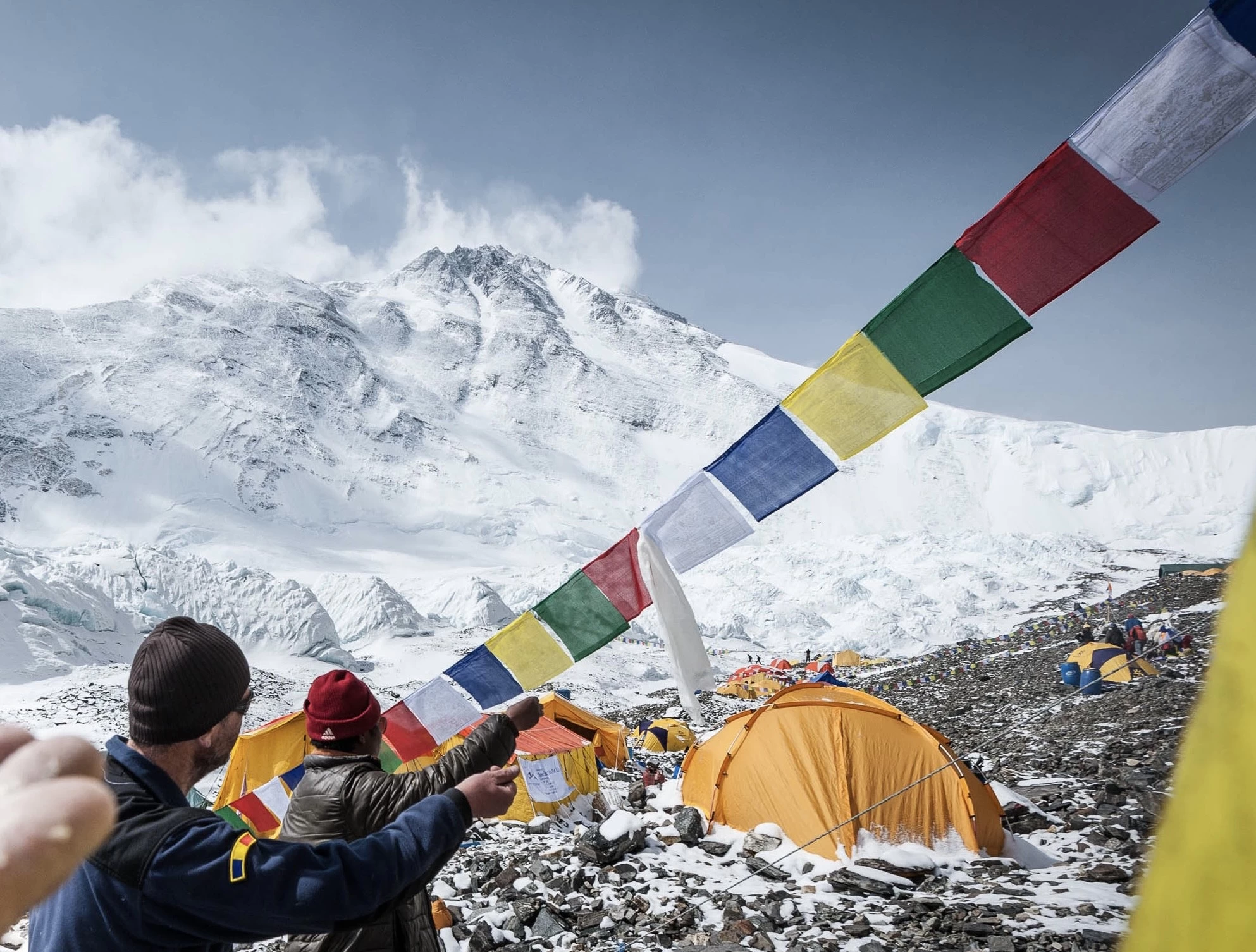
Before climbing begins, a traditional Sherpa Puja ceremony is performed at Base Camp. This sacred ritual seeks blessings from the mountain gods for safety, success, and harmony.
Ama Dablam holds deep cultural meaning:
This cultural experience is not symbolic—it is a living tradition that connects climbers to the spiritual identity of the Himalayas and reflects the authenticity of Sherpa-led expeditions.
The primary climbing season with stable weather, clear skies, and optimal route conditions. This is when Ama Dablam sees the highest success rates.
However, climbers must remain flexible. In recent seasons, route fixing on Ama Dablam has sometimes been delayed due to weather conditions, with summit windows shifting into mid-October or later.
A secondary season with longer days and stable conditions, though generally more crowded on trekking routes and base camps.
A flexible summit window is essential. Our team continuously monitors weather systems and adjusts summit pushes to maximize safety and success.
The Ama Dablam & Lobuche East Expedition by Adventure Sherpa Tracks is more than a climb—it is a complete Himalayan progression journey.
From the sacred valleys of Gokyo to the technical ridges of Ama Dablam, this expedition combines culture, acclimatization science, and elite mountaineering into one powerful experience guided by expert Sherpa leadership.
It is not just about reaching the summit—it is about becoming a climber capable of it.
Not everyone has 32 days. We understand that.
At Adventure Sherpa Tracks, we offer flexible return options for climbers whose time is limited after summiting. Once you have stood on the summit of Ama Dablam, the long walk back to Lukla is beautiful — but it is also 3–4 days. For many climbers, particularly those with firm return flights or professional commitments, a helicopter departure is the practical and increasingly popular choice.
The most direct option. After descending from the mountain and celebrating at Base Camp, a helicopter can be arranged to fly you directly to Kathmandu in approximately 45–50 minutes. This eliminates 3–4 days of trekking and is the fastest way back to the city.
If Base Camp weather is unsuitable for helicopter landing, Pheriche and Dingboche — both within 1–2 hours' walk from Ama Dablam Base Camp — are established helicopter pickup points with reliable landing conditions.
For climbers who prefer to descend one full day on foot — enjoying the Tengboche Monastery and the upper Khumbu one last time — Namche Bazaar offers the most reliable helicopter connections in the region, with multiple daily services.
The classic exit — 2 days of trekking from Base Camp to Lukla, followed by the scenic mountain flight back to Kathmandu. This is the most affordable return option and is included in the standard expedition fee.
If your schedule allows, walk out. The Khumbu reveals itself differently on the way down — quieter, more reflective, and deeply satisfying after weeks on the mountain. But if time is short, fly with no guilt. The summit is what you came for, and we will make sure your departure is smooth, safe, and well-coordinated — however you choose to go home.
— Adventure Sherpa Tracks Sherpa Team
To arrange a helicopter return, simply inform us at Base Camp or before arrival or departure day. We handle all coordination with the operator, confirm weather windows, and ensure your kit and team are ready. All helicopter costs are settled directly with us in Kathmandu before or after the expedition.
Trip Highlight
DAY
1
Arrive at Tribhuvan International Airport, where our team will receive you. Transfer to your hotel in Kathmandu. The afternoon is for a full expedition briefing: reviewing permits, checking technical gear, and meeting your Sherpa climbing team. Overnight in Kathmandu.
DAY
2
This spare day in Kathmandu is kept relaxed for light sightseeing and expedition preparation. After a slow breakfast, you can visit key cultural sites like Swayambhunath Stupa (Monkey Temple) and Kathmandu Durbar Square for easy walking and city views. Lunch is usually during your sightseeing, followed by time in the afternoon to check gear, organize your duffel bag, and pick up any last-minute items. The rest of the day is for rest, optional massage, and an early dinner. You finish with a final briefing and an early night to be well-prepared for the expedition
DAY
3
An early morning domestic flight to Lukla's Tenzing-Hillary Airport — one of the world's most dramatic landings. Begin trekking through the Dudh Kosi valley to the village of Phakding. Distance: 8 km | 3–4 hrs | Overnight teahouse
DAY
4
A classic Khumbu trail day: cross multiple suspension bridges over roaring glacial rivers, including the famous Hillary Bridge. The trail climbs steeply through forests of rhododendron and birch. Your first glimpse of Everest appears as you crest the ridge before Namche. Distance: 11 km | 5–6 hrs | Overnight teahouse.
DAY
5
Namche Bazaar is the gateway to the Khumbu — a vibrant Sherpa town with bakeries, gear shops, and the legendary Saturday market. Today we hike high and sleep low: a morning walk to the Everest View Hotel (3,880m) reveals the full panorama of Ama Dablam, Thamserku, and Kongde. Distance: 4 km | 3–4 hrs optional.
DAY
6
We leave the Everest Base Camp trail and head northwest into the quieter Gokyo Valley. The trail climbs through dense rhododendron and juniper forest before opening onto wide alpine ridges. Dole is a small yak herders' settlement with sweeping views of Kantega and Thamserku. Distance: 10 km | 5–6 hrs | Overnight teahouse.
DAY
7
A steady climb through increasingly open terrain. Yaks roam the high pastures and the air grows noticeably thinner. From Machhermo, the first views of the Ngozumpa Glacier — the longest glacier in Nepal — appear to the north. Distance: 6 km | 4–5 hrs | Overnight teahouse.
DAY
8
The trail passes Longponga Lake and Taujung Lake before arriving at the sacred Gokyo Valley. The third Gokyo Lake, Dudh Pokhari, shimmers an impossible turquoise beneath the Ngozumpa Glacier. Gokyo village is small, peaceful, and staggeringly beautiful. Distance: 8 km | 4–5 hrs | Overnight teahouse.
DAY
9
Today's acclimatization hike ascends Gokyo Ri — the viewpoint hill above the valley — for one of the finest panoramas in the Himalayas. Four eight-thousanders are visible: Everest (8,849m), Cho Oyu (8,201m), Lhotse (8,516m), and Makalu (8,485m). This is also your first sight of Ama Dablam's distinctive silhouette. Round trip: 6 km | 4–5 hrs.
DAY
10
The trek from Gokyo to Thagnak is a short but important step on the way toward crossing Cho La Pass. You begin from the beautiful area of Gokyo Lakes and follow a mostly gradual trail along the valley, with sections of rocky terrain and glacial moraine. The route offers stunning views of surrounding peaks and the Ngozumpa Glacier as you slowly descend and contour toward Thagnak. The walk usually takes around 3–4 hours depending on pace and conditions. You arrive at the small settlement of Thagnak, where you rest and prepare for the next day’s challenging Cho La Pass crossing.
DAY
11
The most demanding trekking day of the expedition. The trail climbs steeply onto the Cho La glacier, crosses the high pass at 5,420m on glacier and moraine, then descends rocky switchbacks to Dzongla. An early start is essential. Crampons and ice axes may be required depending on conditions. Distance: 12 km | 7–8 hrs | Overnight teahouse.
DAY
12
A shorter, recuperative stage through dramatic moraine landscapes. The pyramidal shape of Lobuche East appears clearly to the north as you approach the settlement. Rest well — tomorrow begins the technical climbing. Distance: 5 km | 3–4 hrs | Overnight teahouse.
DAY
13
Trek up the valley to Lobuche East Base Camp beneath the mountain’s impressive south face. Upon arrival, your Sherpa team will establish camp and prepare climbing equipment. After lunch, participate in a comprehensive climbing briefing covering crampon use, fixed-rope techniques, ascending with a jumar, and rappelling. The following day, begin your ascent along the lower South-East Ridge of Lobuche East, using fixed ropes as the route steepens through mixed rock and ice terrain. Continue to High Camp, situated on a narrow col with spectacular views of Pumori and the Khumbu Icefall. Overnight in tents. Walking time: 4 - 6 hours
DAY
14
Summit day begins with a pre-dawn departure, typically between 2:00 and 3:00 AM. Following fixed ropes, you climb steep snow, ice, and mixed rock terrain along Lobuche East's upper ridge. The final ascent leads up a snow slope to the summit, where breathtaking views stretch across the Himalayas, including Ama Dablam, Nuptse, Lhotse, and Everest. After celebrating your achievement, descend carefully back to Base Camp. Depending on your pace, weather conditions, and overall team progress, it may also be possible to continue descending to Dingboche or even Pangboche the same day. Distance: 6 km round trip to the summit | 8–10 hours | Overnight at Base Camp, Dingboche, or Pangboche.
DAY
15
Buffer day for weather delays or extra recovery time. If conditions have been favorable and the team is strong, this day allows a relaxed, unhurried transition to the Ama Dablam approach. No pressure.
DAY
16
Trek back down to the main valley and follow the trail toward Tengboche, then cut east toward the base of Ama Dablam. As you round the final ridge, the mountain appears in full — enormous, technical, and magnificent. Base Camp sits on a grassy moraine with the South-East Ridge rising directly above. Distance: 14 km | 6–7 hrs | Overnight tent
DAY
17
Rest, organize equipment, and meet the full climbing team. In the afternoon, the traditional Sherpa puja ceremony takes place: the lama blesses the expedition, the mountain, and every climber. Juniper incense burns, prayer flags are raised, and offerings are made to the gods of the mountain. This is the spiritual heart of every Sherpa-led expedition.
DAY
24
After completing acclimatization through the Cho La Pass crossing and the climb of Lobuche East, climbers are already well adapted to high altitude before arriving at Ama Dablam Base Camp. Because of this strong acclimatization schedule, we generally aim to make the summit push in a single continuous rotation through Camp 1, Camp 2, and Camp 3 rather than doing multiple carry rotations on the mountain. This approach helps reduce unnecessary exposure to objective hazards, minimizes fatigue, and allows the team to move more efficiently during stable weather windows. The ascent follows Ama Dablam’s dramatic South-East Ridge, climbing steep rocky terrain before joining fixed ropes toward Camp 1 (5,600m), perched on a narrow exposed ridge. The route then continues toward Camp 2 (5,900m) near the famous Yellow Tower, where the climbing becomes increasingly technical with exposed traverses, steep rock sections, and mixed snow and ice terrain. Higher up, Camp 3 serves as the final staging point before the summit push. Summit day usually begins before dawn, climbing through steep snow slopes and technical mixed terrain under headlamps. The final summit ridge is narrow, exposed, and incredibly rewarding, with breathtaking views of Everest, Lhotse, Makalu, Baruntse, and the surrounding Khumbu peaks. After reaching the summit of Ama Dablam (6,812m), climbers descend carefully back through the camps toward Base Camp. However, mountain strategy always depends on weather conditions, route conditions, team strength, and seasonal congestion on Ama Dablam. During busy periods, adjustments may be made to avoid overcrowding on technical sections and reduce waiting time on fixed ropes, helping improve overall safety and lower objective risk on the mountain.
DAY
25
Departure: 1:00–2:00 AM. The summit ridge of Ama Dablam is narrow, exposed, and utterly magnificent. The final meters are a knife-edge of snow and ice. At the top: Everest directly to the north, Lhotse and Makalu to the east, Cho Oyu to the west. A moment earned over weeks of preparation. Descend to Camp 2 the same day. Distance: 3 km round trip | 10–12 hrs.
DAY
26
Full descent from Camp 2 through Camp 1 to Base Camp. Let the relief, exhaustion, and joy arrive in their own time. Your Sherpa team will have hot food and tea waiting. Tonight belongs to the team. Distance: 6 km | 5–6 hrs
DAY
27
Reserve a day for an alternative summit window if weather blocked. If the summit was reached, use this for a well-earned rest or as flexibility for the return journey.
DAY
28
Begin the walk out from the Khumbu. The descent is long but joyful. Visit the ancient Tengboche Monastery — one of the most important Buddhist sites in Nepal — for a final blessing and moment of reflection beneath Ama Dablam. Distance: 9 km | 4–5 hrs.
DAY
29
A long, satisfying descent on a familiar trail. The forests return, the air thickens, and the body begins to recover at lower altitude. Namche Bazaar feels like civilization after weeks on the mountain. Distance: 11 km | 4–5 hrs.
DAY
30
The final long trail day — 19 kilometers that feel both endless and bittersweet. The Khumbu Valley reveals itself one last time as you descend into the tree line and arrive in Lukla. Celebrate with your Sherpa team tonight. Distance: 19 km | 6–7 hrs.
DAY
31
Morning flight back to Kathmandu. Afternoon at leisure for final shopping, hot showers, and civilization. Evening: farewell dinner with your Sherpa team. Stories, laughter, and gratitude.
DAY
32
Airport transfer to Tribhuvan International Airport. End of expedition. Until the mountains call again.
Trip Start: 2026-10-20
Trip End: 2026-11-14
spots available
The main emphasis while on the adventure is on keeping warm and dry while still being lightweight. You should bring a rucksack or backpack for the gear required during the day. Your pack should contain items such as warm clothes, a jacket, a camera, water bottles, a personal first aid kit, and snacks. The weight limit is 5kg. A porter will carry the rest of your personal equipment packed in a duffel or kit bag. The weight limit for your duffel bag is 15 kg however it is different in the case of peak climbing and expedition.
Ama Dablam requires various types of gear both technical and non-technical. It might be confusing what to or not to bring along on your expedition. So, we have made this Ama Dablam Equipment list to make your task easier.
Climbing Gear
Hardware
Camp Accessories
Footwear
Clothing
Outerwear Accessories
Personal Accessories
Travel Items
Trekking Gear
1
Yes — this is non-negotiable. Ama Dablam is a technically demanding peak and not suitable for beginners. We require at least one prior summit above 6,000m, ideally Island Peak (6,189m), Mera Peak (6,476m), or Lobuche East (6,119m). If you have not yet climbed at this level, we strongly recommend completing one of these peaks first. We offer these as separate expeditions and can advise you on the right progression.
2
This is our signature approach and it makes a measurable difference. By summiting Lobuche East first via the Gokyo Valley and Cho La Pass, your body acclimatizes gradually on real technical terrain rather than sitting in a Base Camp tent waiting. You arrive at Ama Dablam Base Camp already altitude-adapted, technically warmed up, and mentally confident. Our summit success rate on this combined itinerary is consistently higher than on direct approaches
3
You must be competent in the following before arrival: Ascending and descending fixed ropes using a jumar and rappel device Crampon technique on 50–70° ice and snow slopes Rock climbing in mountaineering boots (UIAA IV+ / approximately 5.7 in cold and gloved conditions) Self-rescue fundamentals on a rope If any of these are unfamiliar, please train specifically before joining. We can recommend pre-expedition training programs.
4
Autumn (October–November) is the primary season and the one we recommend. Skies are clear after the monsoon, winds are generally stable, and the route fixing on Ama Dablam typically takes place in early-to-mid October. Spring (April–May) is the secondary season but brings heavier traffic on the mountain and less predictable snow conditions on Lobuche East. We operate exclusively in autumn for this combined itinerary
5
We build three contingency days into this itinerary — one after Lobuche East and two during the Ama Dablam climbing phase. These are genuine weather buffers, not padding. If a summit window is missed, we wait and attempt again within the buffer period. Your Sherpa guide receives daily professional weather forecasts from Kathmandu throughout the expedition. Strict turnaround times are enforced regardless of how close you are to the summit — your safety is the only priority.
6
You need to bring your own gear that fits you and that you have trained in. Renting unfamiliar double boots or a harness at altitude is a serious risk. However, some items — down suits, sleeping bags, and certain hardware — are available for rental in Kathmandu's Thamel district and in Namche Bazaar. We will send you a full gear list upon booking and advise on what is practical to rent versus bring.
7
Very fit. You must be capable of carrying a 10–12 kg pack for 7–9 hours per day for multiple consecutive days, and then performing technical climbing at altitude above 6,000m. We recommend a training program that includes weighted hiking, cardiovascular endurance (running, cycling), and gym-based strength work — beginning at least 6 months before departure. We can connect you with a specialist high-altitude fitness coach on request.
8
Mountaineering carries no summit guarantee — weather, health, and mountain conditions are beyond anyone's control. The expedition fee covers the full cost of the journey, the team, and the logistics, regardless of summit outcome. We do not offer partial refunds for missed summits. What we guarantee is the absolute best effort from our Sherpa team, a safe and well-organized expedition, and an experience that will stay with you for the rest of your life — summit or not.